Acrylic vs Polycarbonate: Which Material Is Better for Custom Displays and Commercial Products?
Introduction
For many buyers, choosing between Acrylic and Polycarbonate can be a difficult decision—both are mainstream transparent plastics with similar appearances, yet their actual performance differs significantly. Acrylic excels in light transmittance comparable to glass and has a high surface gloss, making it suitable for applications such as display racks, light boxes, and decorative panels where clarity and aesthetics are paramount. Polycarbonate, on the other hand, is known for its superior impact resistance and temperature resistance, making it the preferred choice for applications with stringent safety and durability requirements, such as protective face shields, machinery housings, and outdoor skylights. This article will compare the core characteristics, cost differences, and typical applications of both materials to help buyers avoid the misconception of solely focusing on transparency and accurately select the material best suited to their needs.
What Is Acrylic?&Key Characteristics of Acrylic
Acrylic, chemically known as polymethyl methacrylate (PMMA), is an important thermoplastic that was developed relatively early. As a high-performance transparent material, PMMA is often considered the best alternative to glass. It boasts a light transmittance of up to 92%, excellent optical transparency, and a high gloss comparable to a mirror. In addition to its superior visual performance, acrylic also has good UV resistance and does not easily yellow or become brittle with long-term outdoor use. Furthermore, it is lightweight, weighing only half as much as ordinary glass, and is easy to cut, engrave, and heat-bend, making it widely used in advertising light boxes, architectural lighting, and high-end display props.
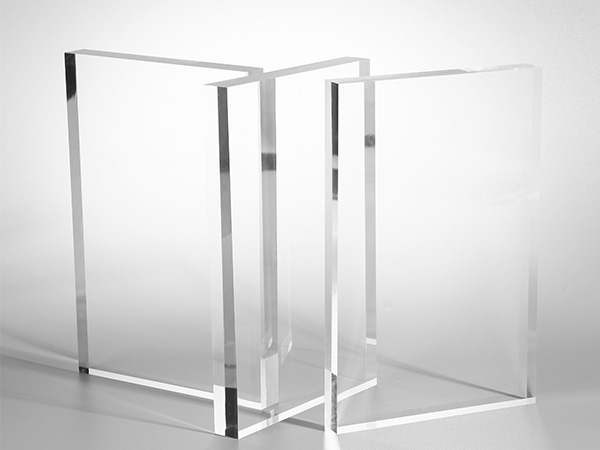
Thanks to its high light transmittance of 92% and excellent optical transparency, acrylic has become the preferred material for cosmetic and retail displays. It can reproduce the color and texture of lipsticks and skincare products without distortion, like crystal, giving the merchandise a sophisticated "floating focus" visual effect on display stands, directly stimulating consumer decisions.
For acrylic boxes, their lightweight and UV-resistant properties facilitate daily handling and restocking, while also preventing yellowing and brittleness from prolonged exposure to sunlight in window displays or outdoor exhibitions, providing long-lasting, clean, and dust-proof protection for collectibles or high-priced items.
In the production of sign holders and various retail displays, the ease of processing is maximized: through laser cutting, heat bending, and screen printing, irregularly shaped structures, seamless splicing, and customized brand logos can be quickly achieved, balancing a high-gloss modern aesthetic with the practical efficiency of modular installation, perfectly adapting to the diverse display needs of pop-up stores, supermarket shelves, and department store counters.
Overall, acrylic combines the visual appeal of glass with the lightweight properties of plastic, providing comprehensive display solutions for all scenarios, from high-end beauty product displays to everyday retail signage.
What Is Polycarbonate?&Key Characteristics
Polycarbonate (PC) is a high-performance engineering plastic renowned for its toughness. Unlike acrylic, which prioritizes aesthetics, PC's core value lies in its exceptional impact resistance—its toughness is 250 times that of ordinary glass and 30 times that of acrylic. Even under strong impacts, it is not easily broken, hence its common nickname, "bulletproof plastic."
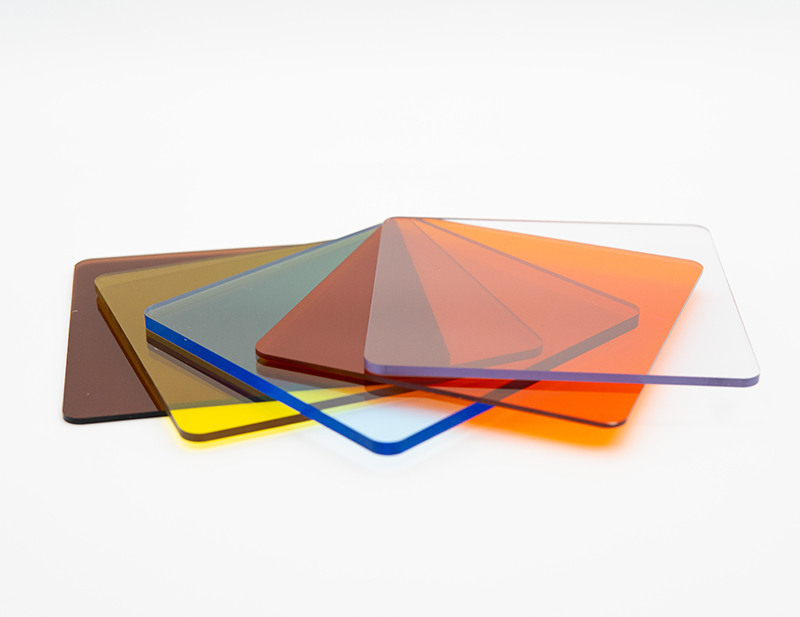
Due to its excellent heat resistance and mechanical strength, PC is rarely used in high-end display applications that prioritize high light transmittance and sophisticated appearance. Instead, it serves as a "safety guardian" in the industrial sector. It is widely used in scenarios with stringent safety requirements, such as machine guards, safety masks, explosion-proof glass, and various high-strength industrial parts. Simply put, if acrylic is for "visible beauty," polycarbonate is for "invisible stability."
How to choose between Acrylic and Polycarbonate
Acrylic (PMMA) vs. Polycarbonate (PC)
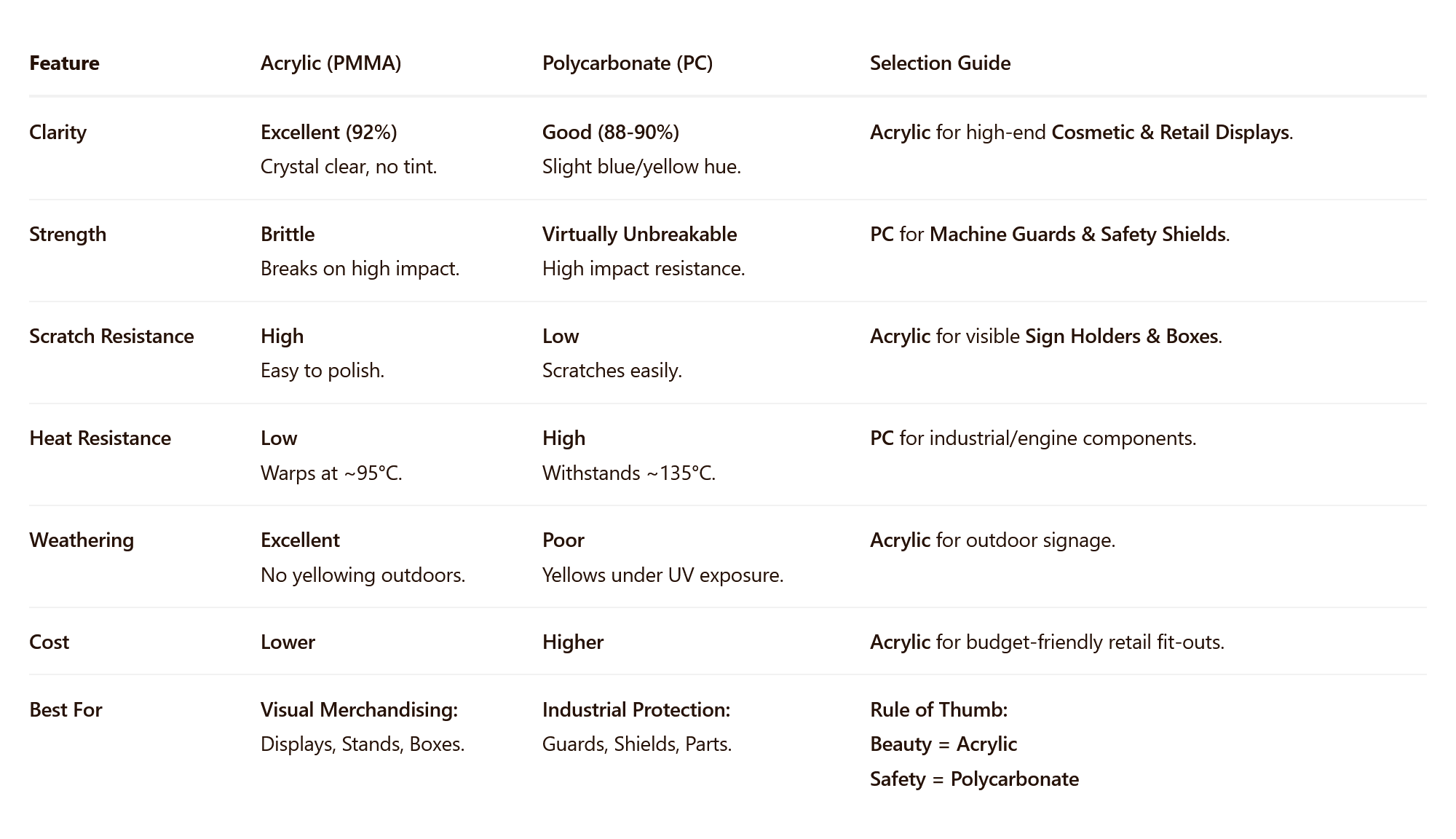
If your needs are for displaying merchandise, making signs, light boxes, or indoor display props—choose Acrylic (PMMA) without hesitation. It's the most aesthetically pleasing, clearest, and offers the best value.
If your needs are for protective covers, sound barriers, helmets, or structural components requiring impact resistance—you must choose Polycarbonate (PC). It's the most impact-resistant and heat-resistant.
FAQ
4.Acrylic vs Wood Display
5.How to customize acrylic
7.Is cast acrylic better than extruded acrylic?
8.What thickness of acrylic should I choose?
10.Can acrylic be CNC machined?